
5K/10K
About character, and building it.

Of all the traits I consider innate to myself, one of which I’m most proud is my propensity for discipline. Memory will always explain best, so here’s one.
My first date was in senior year of high school. I was wearing a shirt I’d borrowed from Liza, and jeans Liza had in turn borrowed from their father. October was warm that year, I remember. I had made my way to Central Park with a backpack of homework and the mistaken impression that we would study. I carried with me a great deal of nervous anticipation, but also Latin homework, and a few chapters of Frankenstein to read. I eventually found my counterpart at an entrance on the West Side, and together we walked through the park before settling in a shaded lawn overlooking Bow Bridge. It surely had the potential to be romantic. Yet instead, rather abruptly, I opened my book and started to read, and I did not stop until I had finished my planned chapters. Later, we would laugh at the sheer stubbornness with which I had been undeterred the boy sitting next to me—who, it seems, had not brought any homework at all.

Though if listing innate traits, there are also those I am not proud of. One of these has been obvious from a young age: namely, my instinctive refusal to do things I am not immediately good at. Another memory stands out as example.
It was some elementary summer in Denmark. My parents had enrolled me in a week-long horse-riding camp, possibly aimed to socialize me with other girls my age. It was an understated, overnight program, and most of the girls had both been coming for years and loved horses, two qualities I markedly lacked. I felt awkward not only on horseback, but around them too. The instructor continuously corrected me in a Danish I could only loosely understand. On my first day, I spent any un-programmed hours hiding in the stable, playing with the barn kittens and avoiding my campmates for fear it wouldn’t go well. Later that night, I crawled into my tent and called my father, feigning stomach sickness and asking to be picked up. The lie was obvious, as was the statement in regards to my character.
Another trait of mine, on which I pronounce no value judgement: that I dislike running. Though I’ve run occasionally in my life, both willingly and unwillingly, I’ve never enjoyed it. Moreover, I’ve always felt innately unsuited for it. In high school, I often joked with my swim friends that it was like making a fish walk. When I had to run the pacer or the mile, I felt that my joints, pampered by years of swimming, didn’t take well to impact, and I took this—along with a brief, 3rd grade asthma encounter—as a mandate to reject running. As my two best friends began to cement themselves as runners (and have now been runners for the better part of a decade), I did what many teenagers do, and fashioned myself as something oppositional. I was, decidedly, not a runner.

What to do with traits that seem in overt contradiction to one another? A propensity for discipline, and yet another for quitting? The first comes, in all honesty, with a strong caveat: I’ve only been disciplined at things that are not all that difficult for me to disciplined about. By the end of 2024, having mulled over this contradiction for some years, I decided that I would see when a quitting penchant meets a pure stubbornness to not. I decided to do what many people my age do: in the new year, I would run.

Last week, Ebonee sent me an article coincidentally published in The Atlantic just a few days ago, entitled “Why I Run.” Written by a cancer survivor who runs 2:43 marathons while also being a CEO (of, you guessed it, The Atlantic), it’s an understandably lofty piece. And though the essay begins by suggesting the author’s father as the reason “why [he] runs,” it quickly becomes clear that instead running functions as a metaphor for greatness in the author’s life. The level at which he can run becomes symbolic of the level at which his entire life operates. This level, we learn as we read on, is extraordinarily high: by the end of the essay, the author has set multiple age-group records and started to run ultra-marathons. His goal is to run (read: live), incredibly. Mine, back in January, was just to finish a 5k at whatever pace, whenever I could.
Though to say my goal was only to finish the 5k would be incomplete. My resolution was more specific: to complete a full cycle of Couch-to-5k, an online running program designed so that after nine weeks, participants will be able to run five straight kilometers. The idea is that if you commit to the program three times a week, each week slightly increasing the distance you walk/run, by the end you’ll naturally find yourself at a new level of capability. My goal was thus not only to finish a 5k, but the weeks before it. This was a distinction that I ended up having to make to many people, who questioned why I didn’t just see if I could run a 5k off the bat. In these moments I found myself wanting to explain that the goal of “running” was not actually just about running, it was more of a metaphor, you see, something I’d like to prove to myself, about consistency, discipline, etc., and really, you’d have to go back to my childhood to understand fully why. And even I could see this was too long and pretentious. It’s why I’m writing a Substack about it instead. In those early months, I often just said that I liked the routine.

Because I had some time recently, I sat down on a Sunday and re-read in one sitting Haruki Murakami’s memoir, What I Talk About When I Talk About Running. This is something I haven’t done in a while, but was a nice reminder of my reading endurance. What I Talk About is a good book, if maybe over-quoted and over-referenced for the simple fact that it is so clearly about running, and so many people like to run.
It strikes me, just as it did four years ago, as unpretentious, friendly, and pragmatic. At one point, Murakami writes of leaving Cambridge: “Farewell, Sam Adams draft beer! Good-bye, Dunkin’ Donuts!” It’s the type of book that makes me want to write similarly unpretentiously, similarly pragmatically.
I first read What I Talk About in my senior year of high school, during the segment of my English class that had gone onto Zoom. This was spring of 2020 and my family was quarantining in upstate New York. Inspired by Murakami and what seemed like the end of the world, I decided to try something new, and so I forced myself to run a mile a day.
The path I ran was the same every day, often muddy and slippery from a winter that seemed never-ending in its doom. On these runs I rarely saw another person, save for a masked neighbor or two walking their dog in the early morning hours. At the end of each run I’d stop at a rock and catch my breath, and here the snow would melt into my leggings and make my thighs itch as I walked up the hill home. I hated it each time.
At some point lockdown ceased, and so did running. I started college, swam throughout the four years, and largely forgot about these few months. Still, What I Talk About remains one of my favorite books in one of my favorite genres: memoir.
When Murakami allows us to read What I Talk About as a memoir, he admits to us that to write about the type of runner he is is analogous to telling us the type of person he is. The book opens as such: “[To write] honestly about running and [to write] honestly about myself are nearly the same thing.” In one example, that he’s a long-distance runner he explicitly ties to his lack of competitive spirit, and a certain fine-ness with being alone. There’s less apparent truths that spring up too, which I’ll leave you to read for yourself.
I’ve been thinking about What I Talk About for the better part of the year, ever since I started running again. One of the main pillars around which the book turns is a comparison between writing and running. It’s an obviously appealing experiment. As Claire wrote in her Substack a few months back: “Anyone who has ever run one mile or written one page has compared running and writing.”
For Murakami, this comparison is largely centered around the natural disposition he feels towards both. The first time I read What I Talk About, I was stunned by the ease of the book, which mirrors the ease with which Murakami seemingly both runs and writes. Compare his description of the publishing of his first novel (1978) with his first try at long-distance running (1983):
By the next spring, when I got a phone call from an editor at Gunzo telling me my novel had made the short list, I’d completely forgotten that I’d entered the contest. I’d been so busy with other things. At first I had no idea what he was talking about. But the novel won the prize and was published in the summer. The book was fairly well received. I was thirty, and without really knowing what was going on I suddenly found myself labeled a new, up-and-coming writer.
In May I was in a 15K race around Lake Yamanaka, and in June, wanting to test how far I could run, I did laps around the Imperial Palace in Tokyo. I went around seven times, for a total of 22.4 miles, at a fairly decent pace, and didn’t feel it was that hard. My legs didn’t hurt at all.
It’s a casual attitude that still impresses me today. Yet reading the book this time around, having tried writing publicly and running both for 10 months now, I found myself more drawn to its other elements. I thought about the slow consistency of writing a novel, running a marathon. Re-reading the above sections, I found myself drawn to the formulation of running as a test, the suddenness of change in his life. And I read this line again and again: “I didn’t start running because somebody asked me to become a runner. Just like I didn’t become a novelist because someone asked me to. One day, out of the blue, I wanted to write a novel. And one day, out of the blue, I started to run—simply because I wanted to.” This time, if I’ve learned something about the type of person Murakami is, it’s not that he’s able to run marathons, but that he decided to start.

It was in Goesan that I truly began running. This was a happy coincidence. In a new environment, running became a conversation starter, an “in” to making friends, and an excuse to meet up each day and have breakfast together afterwards. Some of the people to whom I became closest with during that time were people I met through running. Joelle, who was training for her second marathon; Austin, who seemed naturally able to run long distances alongside her; and Eunice, who like me, had swum in school and was not of a running disposition, but was open to trying, a trait I admired in her from the very beginning. To run alongside people I had just met was the first of many lessons in humility I’ve received in Korea.
Eunice and I completed the majority of Couch-to-5k together in the cold mornings of northern Korea’s winter. Eunice ran almost every day of that first month in her knee-length white parka, an image that has become perfectly engrained in my mind. If I close my eyes, I can still see her slowly waddling down the icy steps to the track, a few minutes late “because of her alarm,” puffy hood pulled over her head and hands retreated into her sleeves, sunrise showing on her tired face. Over the course of our runs, Eunice would gradually loosen her puffer, eventually letting it drop on the track like a young snake shedding its skin. My first memories of Korea will always be these mornings. They left my cheeks pulsing with a heat that lasted until the afternoon. While Eunice and I ran (and walked) our steady laps on the track, we would often spot Austin and Joelle, either on their way back from a longer run or coming up from behind, about to lap us as the sky was changing colors.
I remember one morning in Goesan in specific detail. I had had a troubling phone call, which in truth worried me less than my potential response, and the thought of carrying old habits into new places. Yet it was while worrying that I suddenly remembered I had agreed to meet for a run. It was still cold so I forced myself to don my leggings, and over those my sweatpants, and then my hat and my gloves, and leave the room. I made my way down the steps to the track and saw Austin, Eunice, and Joelle already running. It was a bright day, made brighter by the sun reflecting off of the snow, and the air was finally fresh after days of bad quality. My friends waved once they spotted me. The mountains were clear in the distance, and I remember feeling then that if I were a person who ran, then perhaps many other things about me could change as well.


I finished Couch-to-5k sometime in the spring alone. After finishing, I found myself surprisingly certain that I would continue running. For this reason the day did not feel all that significant, because it was not really a conclusion at all.
Since then, I’ve run with varying consistency throughout my year in Korea. The monsoon season forced me to carry my phone in a Ziploc bag. Summer’s onslaught led to a long lull, and I switched to running on a treadmill at the local sports center. With the weather getting colder I’ve found myself more motivated to go out, but not always. I may start wearing my gloves again. Running is by no means the center around which my weeks turn, and it rarely takes priority over other things in my life. Still, it’s become a through-line of the year.
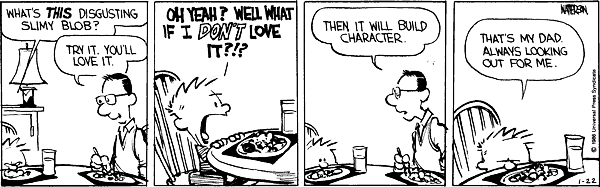
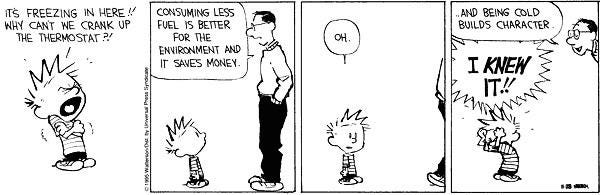
My father and I have many phrases we like to repeat, most of which reference Calvin & Hobbes, or The Far Side. One of our favorites is to say that doing an unpleasant thing “builds character”—this is Calvin’s father’s usual response to why Calvin has to do anything that he doesn’t want to do. “It builds character!” Calvin’s father calls from inside, holding a cup of coffee and watching Calvin shovel snow. My one solace when I run is that even if it feels terrible, forcing myself to do it is at least building character. Probably. During many of my harder runs, I feel like Calvin, and like all the fast runners in the world are Calvin’s dad, laughing at me.
There are, occasionally, “good” runs. Where my breathing feels heavy in the right way and my legs correctly numb. A good run to me comes in the same way a rock is successfully skipped. Though there’s certainly some reason why it has happened as such, these reasons are inapparent to me, and thus the result might as well be magic. I’ve learned not to question it too much
This past Sunday was the New York City Marathon, and it seems like almost everyone I’ve ever known since middle school ran it. Given this, my running a 10k is hardly notable. Still, notable or not, on September 7th I ran a 10k in Seoul, which marked the first time I’ve participated in a road race since the 6th grade. In the week leading up to the race, I found myself wondering not only why I’d signed up, but also why I’d invited my closest friends to witness me. I was aware my time wouldn’t be fast and also, that I am not a necessarily elegant runner. My face turns an off-putting salmon color and becomes strangely puffy.

One of the only relatable parts of What I Talk About comes when Murakami trains in Cambridge a month before the Boston Marathon. He’s running by the Charles River and notices Harvard freshmen passing him. He thinks to himself, “They seem to be used to passing people, and probably not used to being passed. Compared to them I’m pretty used to losing.” He then muses: “There are plenty of things in this world that are way beyond me, plenty of opponents I can never beat.”
I spent the majority of my 10k feeling similarly aware of all of the people in Seoul that were way beyond me. It was not one of my “good” runs. That morning I had drunk too much Gatorade and I felt on the verge of peeing myself the whole second half. Kilometers 7 through 9 felt particularly awful, dragging down a long, boring stretch of central Seoul, only to turn and run it back for another kilometer.
Still, I felt a unique mix of humiliation and pride at putting myself in humiliating situations—this is a feeling that has marked my time in Korea more broadly as well. I noted that while I have spent a lot of my life avoiding arenas in which I will likely be passed, being continuously passed for over an hour, I did not hate the feeling. For Murakami, it was Harvard freshmen; for me, it was an elementary-aged boy, whom I watched run farther and farther ahead of me until I could no longer see him. To be solidly in the back, and be seen there—this, I gathered, was why I had invited my friends. And I was happy to see them.


In my tenth month of living in Masan, I am still finding new paths to run.
One would imagine that the simplest way to find new running paths would be to search online, commute to them, run, and commute back, but I have an inexplicable resistance to this. Instead, I find new paths in this way: rather than turning back at my usual point, I continue onwards and search for off-shoots. Thus, new places only come into focus when I’m able to run further than I was the week before. My radius expands gradually. The most recent path a one you have to cross the parkway to get to, and the stoplight takes forever. Discovery happens slowly.
This path is almost unpopulated, save for occasional pairs of grandparents who value the quiet, and couples who value the anonymity. Roots have been given free reign, and the pine trees stack in a way that hides runners from cars. The soft ground is easier on my knees. Of the many things running has taught me over ten months, a small one is to be kind to my body; not intensely, but rather, in the way a friend at a dinner table might notice there is no water in your cup, and fill it.
Korea doesn’t observe daylight savings, so earlier nights have come in without knocking. Today the sun set at 5:43pm. Coupled with a lack of lampposts, the ascending dark adds a level of excitement to a run. It shifts my brain’s focus from exhaustion to navigation. Separated from other runners, my mind wanders. I sometimes think of an essay by Alison Townsend where she writes about her mind “swimming into the surf, riding the waves back in.” October was warm this year, too, though other things have possibly changed.
When night falls, I like to pretend that I’m a character in the type of fantasy book I might have read in middle school, escaping my camp in the middle of the night and only barely evading capture. Or, I imagine I’m some sort of weight-less, fantastical creature, bounding over the path as though I were always meant to. I’ll admit, though, that my favorite fantasy is more mundane. I pretend I’m someone else, someone who simply enjoys running for the hell of it, and for a minute or two I can almost fool myself into thinking this is true.
Update on my three New Year’s Resolutions (flossing, running, and Substack):
Flossing with a new cardamom flavored floss. Thank you Olive Young!
See above.
September through November was filled with travel: to Daejeon with Eunice and Joelle; to Joelle’s placement with Ebonee; Joe, Sofia, and Charlotte visited Korea (more to come!); Spring Conference on Jeju-do; and Halloween in Seoul. I’ve included a very small fraction of the photos taken below. Travel has been extremely fun and a good way to end the grant year, spending time with the people I’ve met this year before some of us head back, but it’s also meant less time to write. I’m not good at writing in short spurts, so while I imagined publishing this sometime in early October, it’s unfortunately taken a bit longer—also, because I wanted to do some justice to this topic that’s been on my mind for so long.


Finally, life has also been moving on as usual. There are good snacks in the office, the kids are still cute, and my hair is growing.
Cheers!


very beautiful. who else was moved.
Lovely and enjoyable to read your short stories. And running IS good for body and soul.